Donald Diddams
The Art of Digital Art
Narrow-minded
Posted on April 23, 2009
She’s a really sweet dog, even if a little narrow-minded.
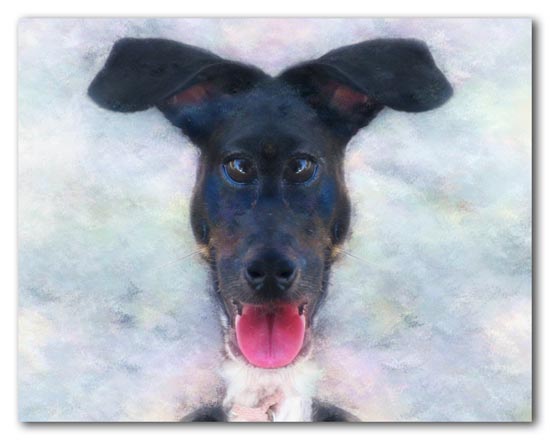
What, me worry?
Colonial-era “Copper”
Posted on April 21, 2009
While enduring a stressful period in one of my other endeavors, it seemed a good time to work on what I hoped would be a peaceful landscape, a pretty picture. This was the result.

Copper - 2009
The object in the foreground is a colonial-era artifact known as a “copper”. These large iron containers were used to boil down the cane juice in the production of sugar during the sugar and slave-trade era in the Caribbean. So even this tranquil scene carries a mixed message from our past, and begs questions about the vestiges of that past that remain.
A Ripe Tomato from the Caribbean
Posted on April 18, 2009
This started out as a ripe tomato from the local organic farm. So sweet and delicious, it’s just a distant relative to what can be bought in the store.
It’s one of those tomatoes that, even when perfectly ripe, is still a mix of brick-red and green. It had delicate rings of tan scar tissue — maybe tomato stretch marks? — and a cleavage from the stem down the back side. Only a tomato, but I think that’s where its magic lies.
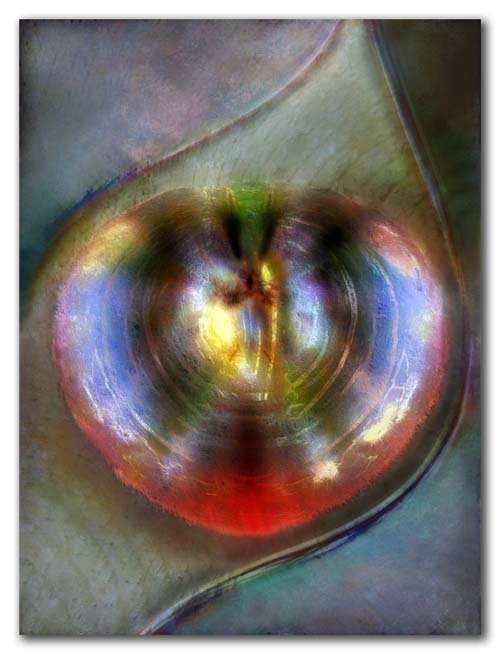
Ripe tomato - 2009
The beautiful eggplant
Posted on April 15, 2009
These tasted as good as they look. No other comment necessary.

Eggplant - 2009
Ironman
Posted on April 11, 2009
You see, there was this “found object” — an old machine part of some sort laying in an abandoned building that inspired the image in the previous post, and this one, and a few others. So in a way, I’m recycling, without even using anything up.
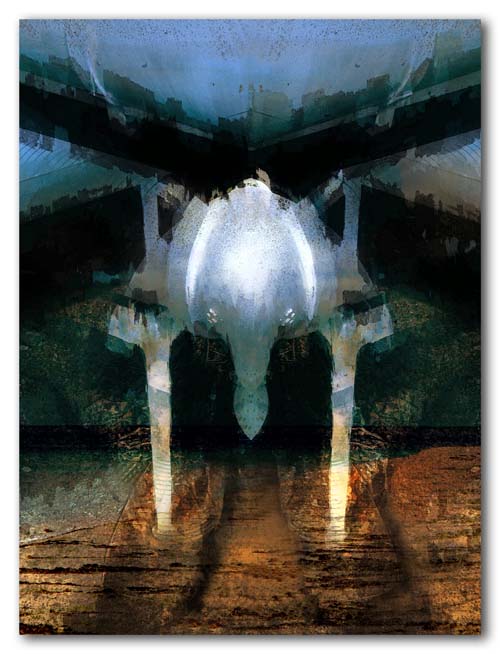
Ironman - 2009
Even in old trash left behind to rust into the ground, there may be some animus, like the spirit of this ironman bearing his heavy load.
Giant Sucking Sound
Posted on April 9, 2009
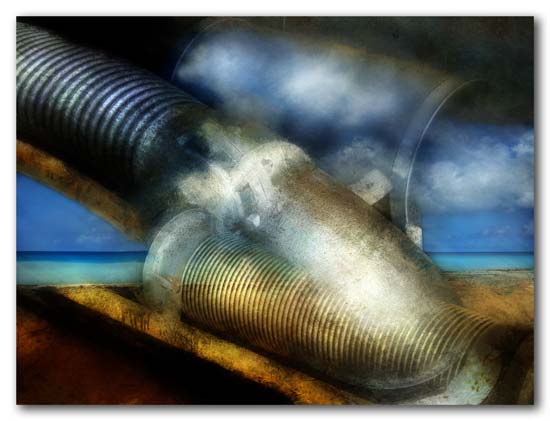
Giant Sucking Sound
It was Ross Perot who popularized the “giant sucking sound” phrase. Living on a Caribbean island we hear that sound sometimes. But in our case it is the sound of major off-island “investors” (a.k.a., developers) sucking the island dry of its fragile and scarce land resources — leaving behind a ruined landscape and a few low-paying service jobs, while removing the value of the precious land they have consumed.
While this is not true of all developers, the islands are hungry enough for more economic activity that our leadership too seldom dinstinguishes among them.
Buck Island View 2
Posted on April 5, 2009
Thanks to Jane Hunt for giving me the blogger’s lemonade award! Jane paints contemplative heavily-textured acrylic landscapes. Check out her blog!
Since I ‘ve just passed on a tag of another award, I will leave this one on countertop for a few days before sending it on to some worthy bloggers helpful to other artists.
Instead, for today, I’ll share a new view of Buck Island, visible from my studio window.
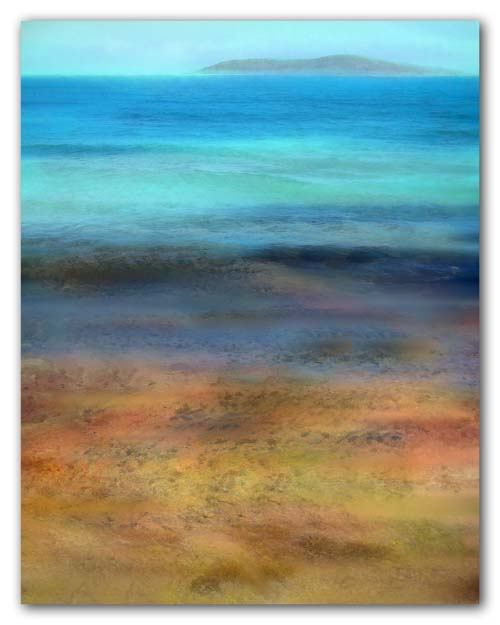
Buck Island View #2
While the island itself plays a role anchoring the top of the frame, the inspiration came from the water and the many colors it takes on from the sand, coral, urchins, depth, sunlight and clouds. It is different every day.
Visit of the Happy Fish
Posted on March 30, 2009
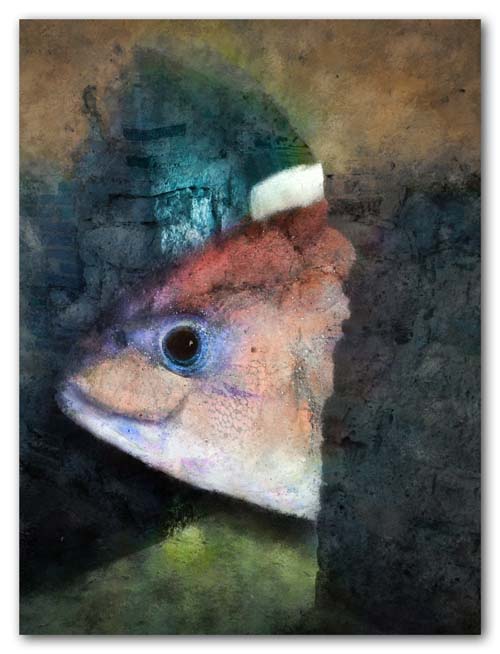
Visit of the Happy Fish - 2009
This guy stopped by the other night, stuck his nose into my private dungeon, smiled and swam off. I’ll probably never know what he wanted.
Sea Grape
Posted on March 25, 2009
When they take the form of a tree, sea grapes have a distinctive shape and silhouette, and an interesting texture with their large round flat red-veined leaves. This one had taken up a traditional position along the shore. The early morning light gave even the green leaves a reddish glow. I eliminated some of the distracting detail to focus on the colors, the light and the simple composition of the original scene.
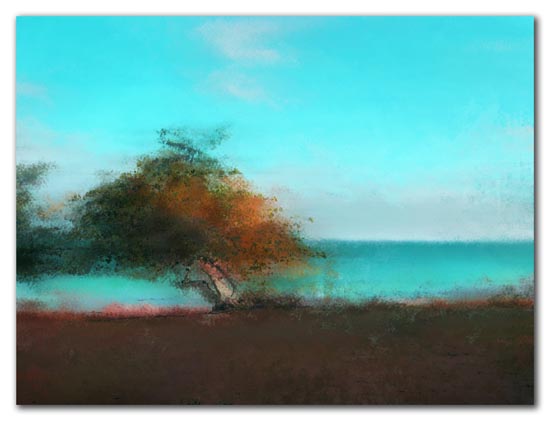
Sea Grape by the Shore - 2009
Chocolate Fruit, the Black Sapote
Posted on March 22, 2009
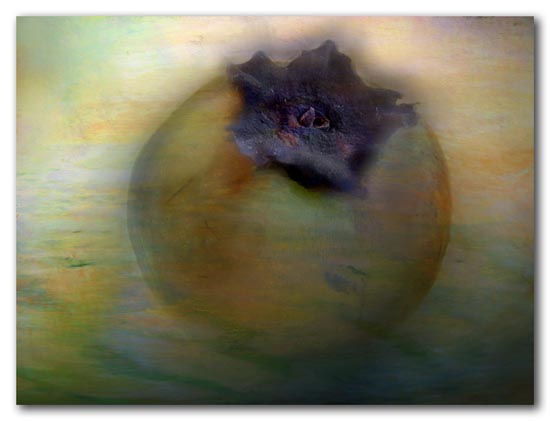
Black Sapote - 2009
A ripe black sapote turns a dark geenish brown, and feels soft underneath the thin leathery skin. Sometimes called the “chocolate fruit”, it doesn’t look appetizing, even when cut open exposing the black-brown custard like interior. But taste it. Looks can be deceiving, and expanding one’s concept of what is edible is rewarding.
In fact, after witnessing the making of a sausage or a bag of Cheetos, I bet you’d much rather eat a black sapote.
Carambola Ice
Posted on March 13, 2009
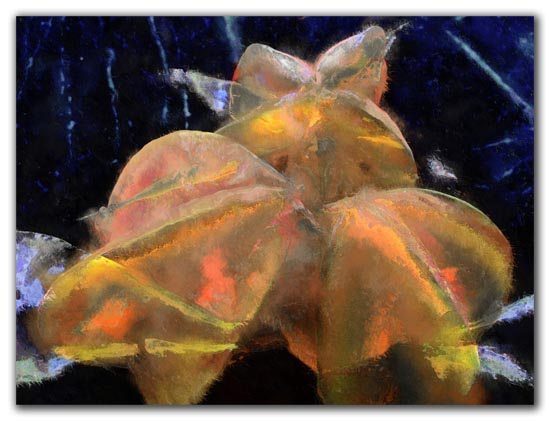
Carambola Ice - 2009
Here is a final image from the carambola still life series. It feels like ice to me.
It is interesting how such different interpretations can emerge from a series of quite similar photographs of the same subject. Work on the final images was started on different days and the result was determined in part by the strengths of each individual photograph — but also in part on the day’s mood and the path chosen for each at the beginning of my process.
Carambola Dream
Posted on March 9, 2009
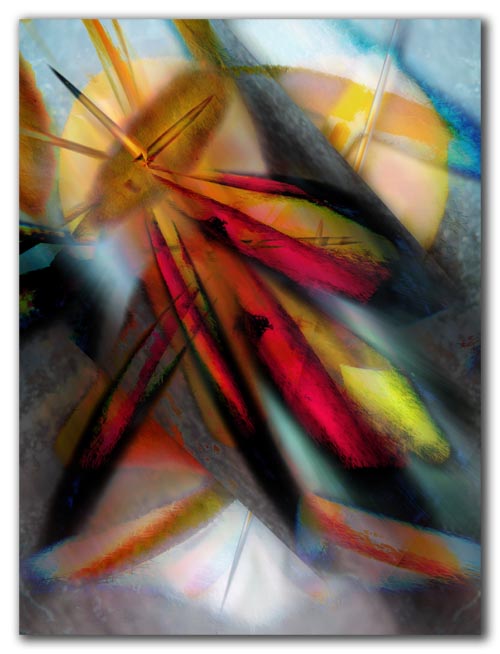
Carambola Dream (2009)
Believe it or not, this too started out as a picture of a carambola — a single fruit on a marble slab.
But it is still there — its gentle curves and angular shapes, ripeness, tartness, splinters of color reflected and from within, and the smooth leathery feel of its skin.
St. Croix — Hotel Caravelle Artwork
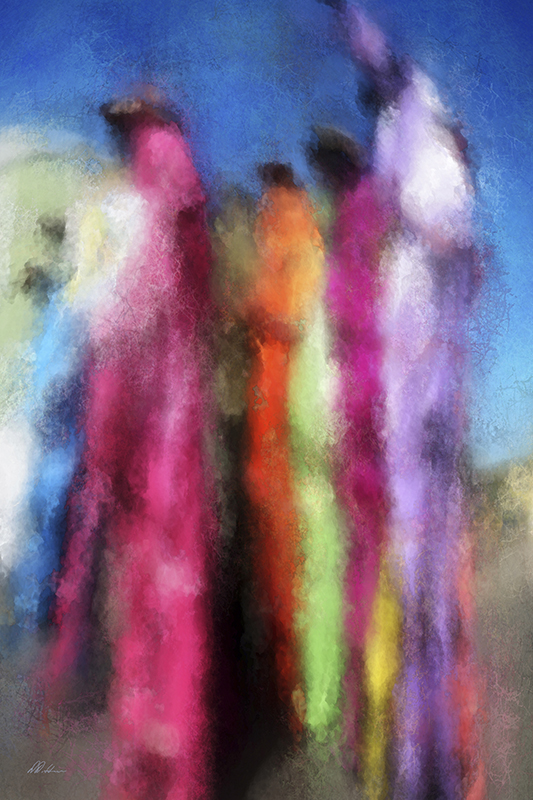
Mocko Jumbies
 Donald Diddams